
Seven Questions for Choosing Your AI Tool for EU Policy Intelligence
The volume of EU policy, regulatory and legislative activity is too large to follow manually.
 May 29, 2026
3 min read
May 29, 2026
3 min read

The volume of EU policy, regulatory and legislative activity is too large to follow manually. And conventional reporting services are not always accurate, fast enough or affordable.
AI tools can really help — but if not competent enough they simply create even more noise: more alerts, more summaries, more generated text — instead of more clarity.
A competent system reduces workload, maximises relevance and produces structured intelligence that professionals can actually trust.
So before buying an AI policy tool, make your vendor sweat by asking 7 pointed questions:
1. Does the system understand EU procedures — or does it just summarise documents?
EU policymaking is heavily procedural. If you’re not on top of that, you’re out of the loop.
A proposed regulation, ECB opinion, committee draft report, trilogue mandate, delegated act or motion for an objection all carry different procedural weight — and they mean different things at different stages.
If an AI tool only retrieves and summarises text, it cannot tell you:
where a file sits in the process
how different documents relate to each other
what their impact is
or what happens next
A useful tool for EU intelligence must understand and respond to questions on procedural significance — not just send alerts and generate summaries.
2. How does the system handle hallucinations and outdated information?
AI-generated text can sound completely plausible while being completely wrong.
Ask:
Are outputs grounded in real sources?
Can claims be verified?
Does the system distinguish objective facts from interpretation and subjective commentary?
Does it indicate uncertainty?
If the platform merely relies on forwarding your queries to generic LLMs, you may simply be getting plausible-sounding AI slop — rather than structured policy intelligence.
Trustworthy systems increase confidence. Weak ones create hidden risk.
3. Does the tool reduce workload — or generate more text to read?
The goal is not more output. The goal is less manual work.
Good systems automate:
workflow-ready reports
personalised briefings
status overviews
accurate summaries
But automation only matters if the output is genuinely usable. Ask whether the tool is trustworthy enough that professionals may realistically circulate its output — without checking everything from scratch.
4. Can it answer complex questions — or does it just query ChatGPT and the internet?
Professionals need more than alerts and summaries. They need an intelligence infrastructure that answers questions about legislative timelines, granular procedural steps, stakeholder positions and source-anchored policy directions.
There is a major difference between querying structured intelligence and simply prompting ChatGPT.
A serious system is reliable because it has already structured and contextualised policy information within the logic of EU decision-making — before you ever ask it. The output must be grounded, traceable and reliable enough to feed directly into real workflows and decisions.
Be cautious with tools that have no such intelligence infrastructure. They may be simple wrappers around generic language models. With those, you are not querying intelligence. You are outsourcing searches to a generic chatbot.
5. Can the tool’s claims be traced to a source?
A competent system can verify:
where information came from
which institution produced it
when it appeared
and at what procedural stage
Direct source access matters. Without traceability, users are forced to trust generated wording instead of evidence.
6. Can the system prioritise relevance intelligently?
A key challenge for anyone working with EU policy is overload.
A strong platform must filter intelligently based on your specific priorities, your professional role, your clients’ exposure and how your interests evolve over time.
The best systems are not those generating the most content. They are the ones consistently surfacing what matters most — and that learn with you as you go.
7. Does the tool monitor only written sources — or also live policy signals?
Important signals often emerge in live events: EP committee hearings, plenary debates, Commission midday press briefings, Council open sessions, leaders’ doorstep comments, and so on.
Policy professionals need to know about spoken word just as much as about written information. That makes policy monitoring not only procedural, contextual and continuous — but also quasi real-time.
A strong intelligence infrastructure informs you what matters, anticipates the next step, answers your questions and feeds into your workflow.
Procedure matters. Ask whether your tool actually understands it.
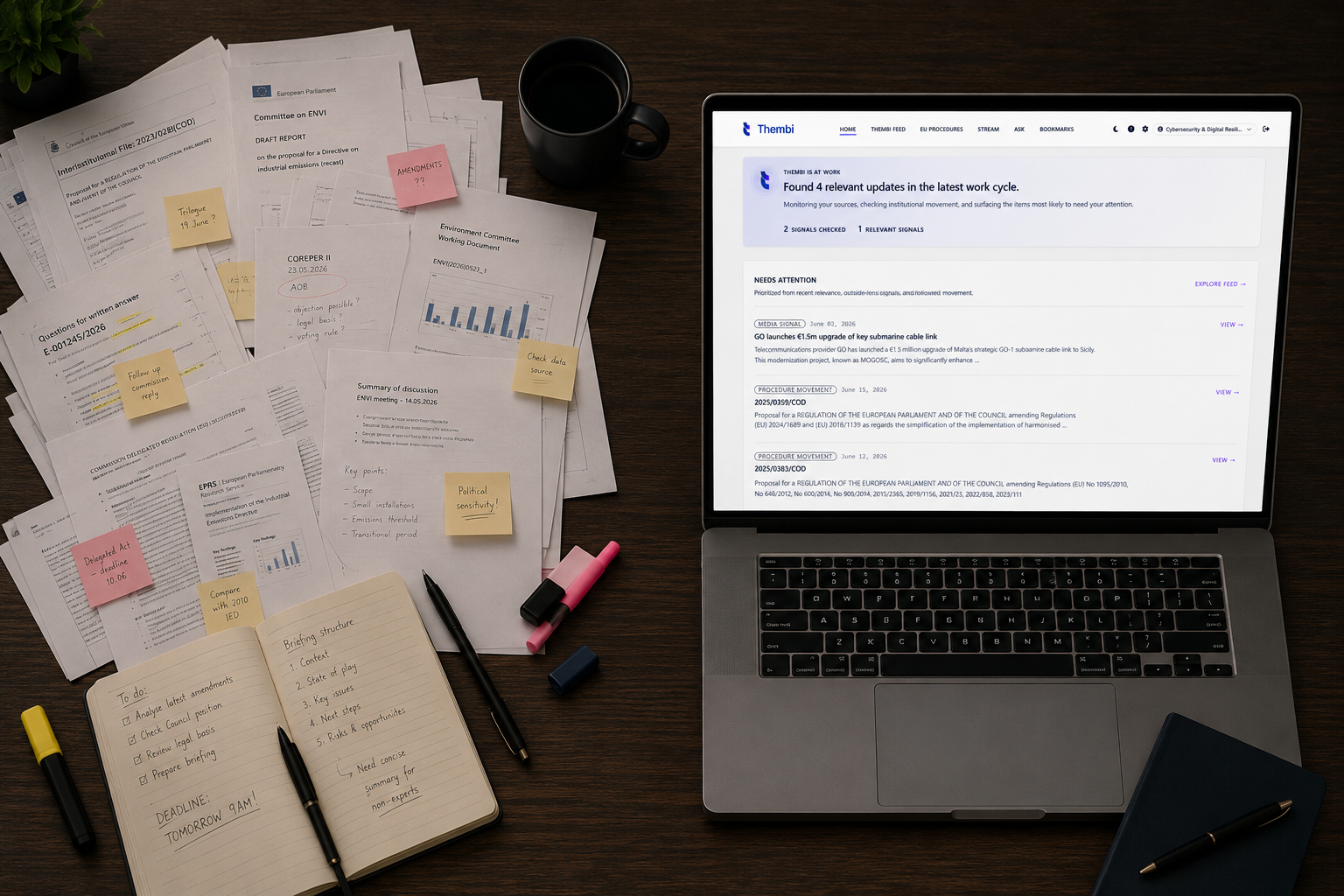
Or Just use Thembi.
Stay in the loop with Thembi
Thembi is grounded EU policy intelligence — every answer linked to the official document it came from. Built for people who'd rather think about their file than reconstruct it.
Don't monitor. Be informed.
Originally published on Substack. Consider subscribing there for updates.
Other Signals
The 30% problem in EU policy work – and how to fix it
Ask anyone in the Brussels bubble where much of their time goes, and you’ll hear a version of the same challenge:
Sebastian Peter Sass 
Lobbying in the Age of AI - Part 2
Complex Use Cases, Regulatory Realities, and the Limits of Automation
Sebastian Peter Sass 
Introducing Thembi: AI for EU policy intelligence
Using responsible AI to help people navigate and engage with Europe’s complex policy-making landscape
Sebastian Peter Sass