
The 30% problem in EU policy work – and how to fix it
Ask anyone in the Brussels bubble where much of their time goes, and you’ll hear a version of the same challenge:
 June 4, 2026
3 min read
June 4, 2026
3 min read
Ask anyone in the Brussels bubble where much of their time goes, and you’ll hear a version of the same challenge:
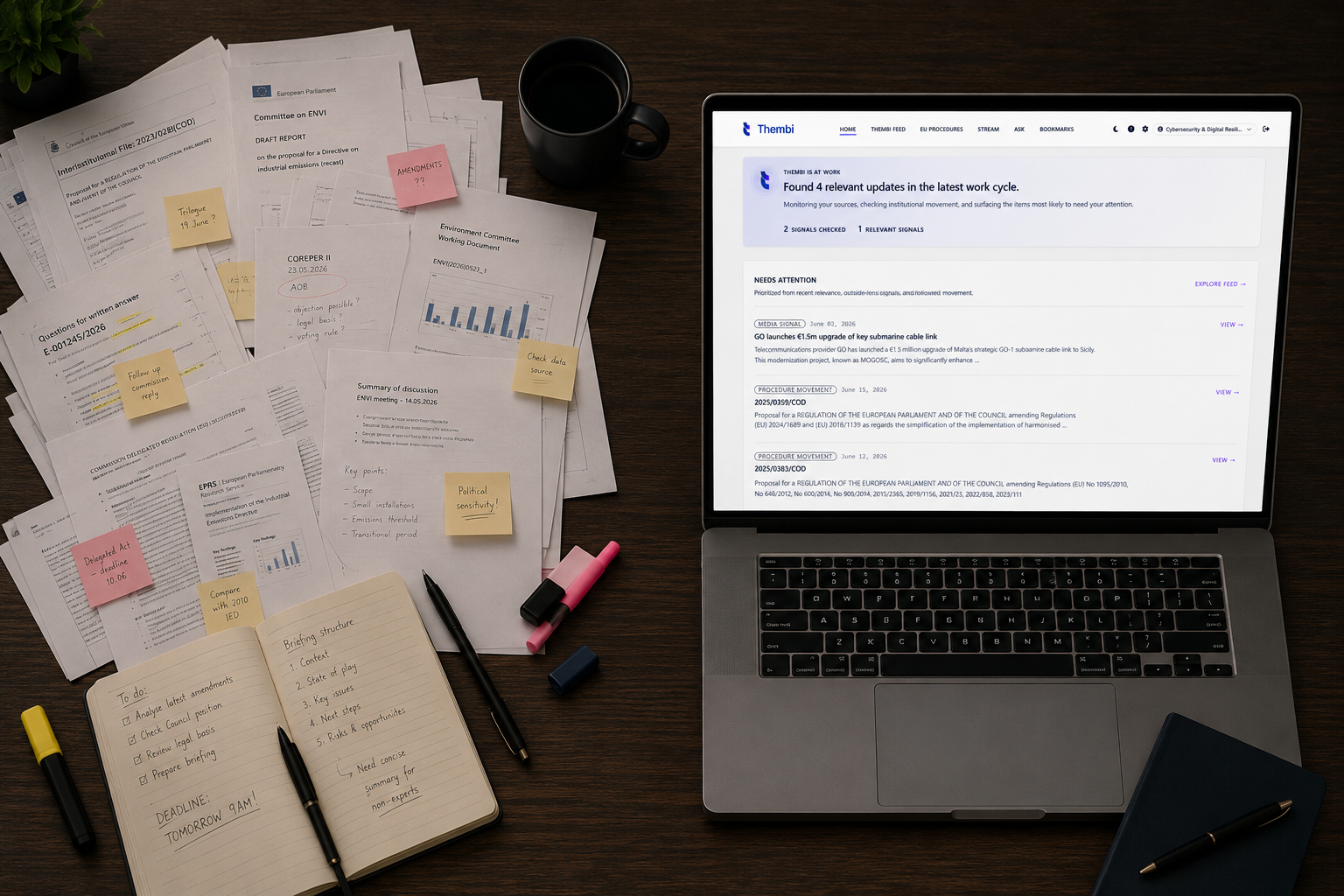
A large share disappears into researching information from scattered sources, inside and outside the EU’s Babylonian labyrinth at europa.eu: the status of a proposed directive, a draft report, who said what in an EP committee hearing, voting results, written questions, a delegated act – and where on earth is that draft motion for an objection against it… You name it.
And when you have finally pieced the information together, you need to consolidate it in a readable report for non-experts. By 10 minutes ago. Diligent, necessary work — but bulk tasks that in 2026 should already be automated. I’ve heard from many professionals – and I know it from my own experience – that up to 30% of work time is easily absorbed by these tasks. Eating into the hours needed for strategy and judgement. And into the after-work hours, anyway.
That’s the practical cost of the EU’s complexity for practitioners. Not the lack of access — but the overwhelming volume and complexity of what you can access. There’s simply too much of it, too fragmented, too procedurally intricate for any individual to stay on top of manually.
This is where AI earns its place addressing the problem – and where it doesn’t:
What it does well: a sophisticated AI system makes enormous amounts of information navigable and finds the needle’s head in a sea of haystacks. It tracks signals across the thickest policy files, tells you the next step in complex procedures and alerts you instantly about relevant mentions in the daily flood of livestreamed EU proceedings. Always grounded in verifiable facts and cross-checked against validated EU procedural rules.
All this, it serves you proactively, including a queryable interface for live proceedings like committee meetings, without you having to ask for any of it. But when you need to ask it “When did the rapporteur last shift position on scope, and where exactly did they say it?” you will get a trustworthy and source-anchored answer. Everything consolidated in a workflow-ready report within seconds.
What it can’t do: first and foremost, your actual job as an expert. Strategic judgment rooted in experience and intuition. Reading the room. Recommendations, decisions and actions requiring human acumen, trusted relationships and political judgment. It cannot and should not do any of the things your job is actually about. But it can make you much better at them by giving you back the hours – for what you should actually be doing at work, and for the time after it.
Reliability is key: whether a system can do any of this depends on how it’s built. A general-purpose assistant such as Copilot – or a standard policy tool that hasn’t deeply internalised how EU lawmaking actually works – will confuse a proposal with a draft report, or a draft with a final act, and invent procedural steps when it doesn’t know better. Whilst a system bound to verified institutional sources, with every claim linked back to its document, behaves entirely differently.
AI’s real value was never to replace policy judgment. It’s to give policy professionals back the hours that judgment actually needs.
Stay in the loop with Thembi
Thembi is grounded EU policy intelligence — every answer linked to the official document it came from. Built for people who'd rather think about their file than reconstruct it.
Don't monitor. Be informed.
Originally published on Substack. Consider subscribing there for updates.
Other Signals

Seven Questions for Choosing Your AI Tool for EU Policy Intelligence
The volume of EU policy, regulatory and legislative activity is too large to follow manually.
Sebastian Peter Sass 
Lobbying in the Age of AI - Part 2
Complex Use Cases, Regulatory Realities, and the Limits of Automation
Sebastian Peter Sass 
Introducing Thembi: AI for EU policy intelligence
Using responsible AI to help people navigate and engage with Europe’s complex policy-making landscape
Sebastian Peter Sass