
When Everyone Has AI, What Gives You an Edge in Brussels?
Public affairs will remain a people business.
 November 10, 2026
5 min read
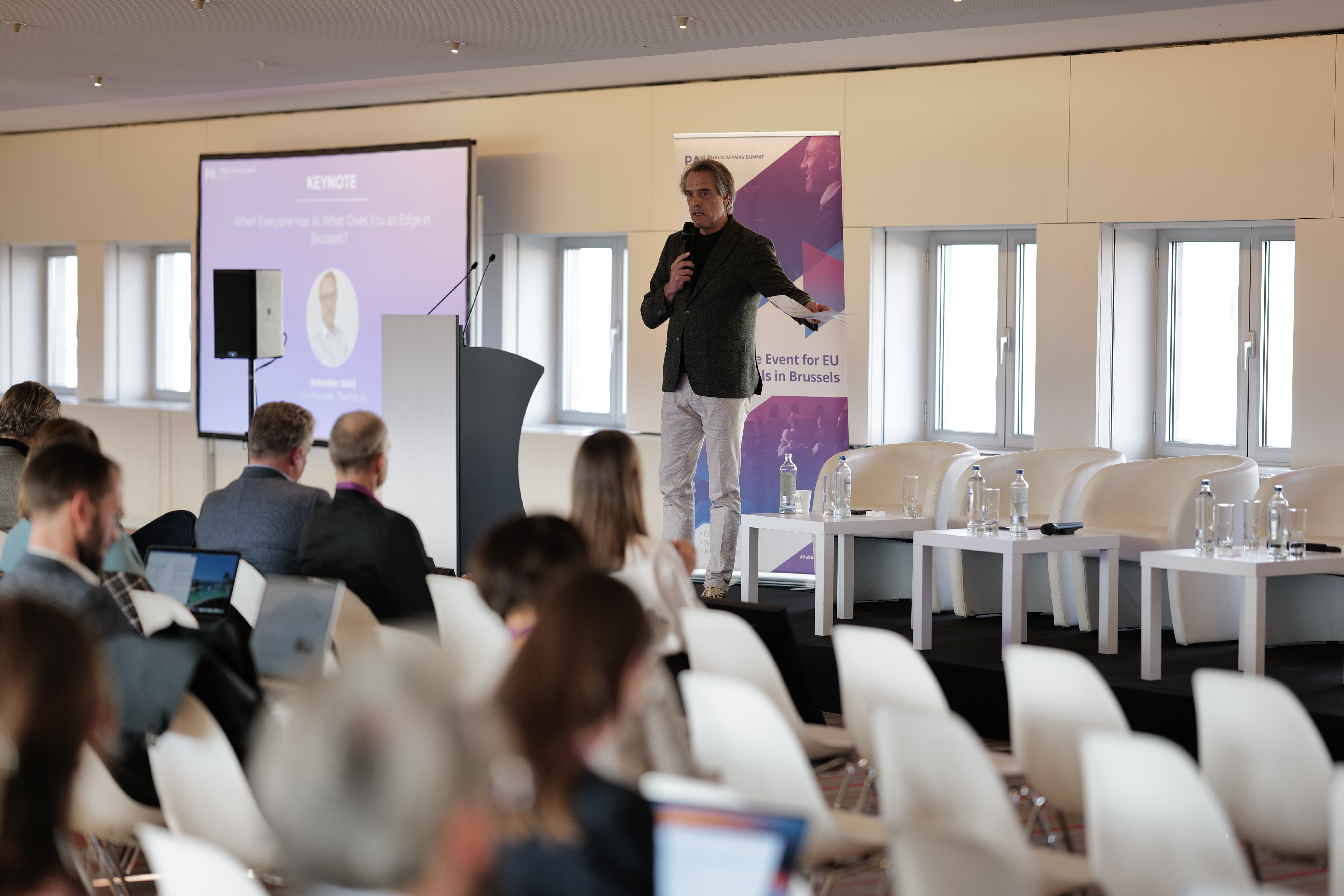
Public affairs will remain a people business. AI can give us much more capacity to make that people business work.
That was the argument at the heart of my keynote at the Public Affairs Summit in Brussels, and the practical question behind our panel on building an AI-first public affairs team. When access to AI becomes commonplace, the advantage lies in what an organisation becomes capable of doing with it.
Industrialisation enters a craft
Our profession has traditionally understood itself as a craft. We learn through experience, build relationships and develop judgement. We analyse the constellation around a decision, understand motivations and procedures, and decide whom to approach, when and with which arguments.
Until recently, substantially increasing the output of that cognitive work generally required more people producing it. AI has begun to change that relationship.
In that sense, public affairs is now undergoing its own industrial revolution: scaling analysis and intellectual output no longer requires proportionately more analysts or professionals.
After years of advising others on transformation, how prepared are we when it changes the production of our own expertise?
More output does not automatically mean more value
I encountered an earlier version of this problem as a student working as a freelance translator. Much of the work involved brochures and user manuals translated into German. Payment was by the word or character: an imperfect measure of value. Standard corporate language could be translated quickly; one unfamiliar culinary term on a restaurant menu might require half an hour of research.
When I began using translation memories, standardised work became much faster. Previously translated passages and terminology could be reused, improving consistency and increasing output.
But clients supplying those databases demanded discounts. I could produce more, yet needed that additional output simply to maintain my income. My previous translations had helped create a valuable asset. The client controlled it and captured part of the productivity gain through lower prices.
Producing more output does not automatically mean capturing more value.
The same question confronts public affairs today. AI can accelerate research, analysis and document production. But where does the saved time go?
The faster we churn things out, the more comes back, especially when everyone else has similar tools. An organisation can make everyone faster without becoming more effective. Everyone’s increased output becomes everyone else’s material to review, respond to and process. When that creates more work without creating more value, it is the opposite of efficiency.
The more demanding question is: what can your organisation now achieve that it could not achieve before?
Resolving a resource conflict?
Imagine developing a compelling compromise among hundreds of articles and thousands of amendments. You examine positions, test arguments and find common ground for a broad coalition supporting the interests you represent.
Every additional hour can make that proposal stronger and more compelling. But every additional hour spent on that is an hour you lack when making it happen.
That is a significant resource conflict—especially for small and even medium-sized organisations. Preparation and implementation compete for the same scarce resources. Large organisations with substantial staff and capacity may not have perceived it that way. Ask a public affairs professional from any other type of organisation about it.
And without people bringing that coalition together and persuading others, even the most compelling compromise is not worth the paper it is written on.
AI offers the opportunity to resolve that resource conflict. Prepare more profoundly. Arrive with more compelling propositions. Increase their chances of adoption, without the preparation of all that depriving you of the means for implementation.
Then pursue implementation more diligently: better prepared, with more capacity to earn trust, negotiate commitments and follow through. The potential is better, more broadly accepted and more firmly rooted outcomes, faster. Better decisions. Better policies.
This is where AI can act as a real force multiplier and help level the playing field. Smaller teams can access a depth of preparation that would previously have required far greater resources, while retaining the capacity to act on it. The benefit extends beyond producing more: it gives more organisations the means to participate effectively.
Turning AI capability into organisational value
This is where the question of an AI-first team becomes practical. Choosing suitable tools and architecture matters enormously. So does deciding how those capabilities fit into the work, who reviews their outputs and where the capacity they release will go.
Technology can advance faster than organisations learn how to benefit from it. Investment in learning and workflow redesign is part of developing an edge. Giving everyone access to AI leaves those organisational decisions unfinished.
Take the compromise example. If AI shortens the research phase, does the team simply accept more research assignments? Or does it use the capacity to test the proposal with potential allies, uncover objections earlier and negotiate a stronger agreement?
Those choices need to be reflected in responsibilities, priorities and expectations. A team still rewarded mainly for the volume of briefings it produces will have little reason to spend its gains differently.
Leaders should ask what deserves less of their people’s time, what deserves more, and what their organisation now achieves as a result. Better preparation, earlier intervention and stronger agreement are more meaningful measures than the number of documents generated.
The opportunity does not require fewer people. It requires a smaller share of their capacity consumed by routine production and a greater share devoted to the work that creates value.
AI also changes how people acquire the judgement this work demands—a question that deserves its own examination.
The human edge
So, paradoxically, when everyone has AI, what gives you an edge in Brussels may well turn out to be everything but AI.
The good news is that the edge remains human. The challenge is to use artificial intelligence to enable that very human advantage in the most efficient way possible.
That is the battleground on which it will be decided who has an edge in Brussels—and who merely has AI.
Turn insight into your next decision.
Ask Thembi to connect EU policy developments, analyse documents and generate reports with sources you can check.
Take the free trialOriginally published on Substack. Consider subscribing there for updates.
Other Signals
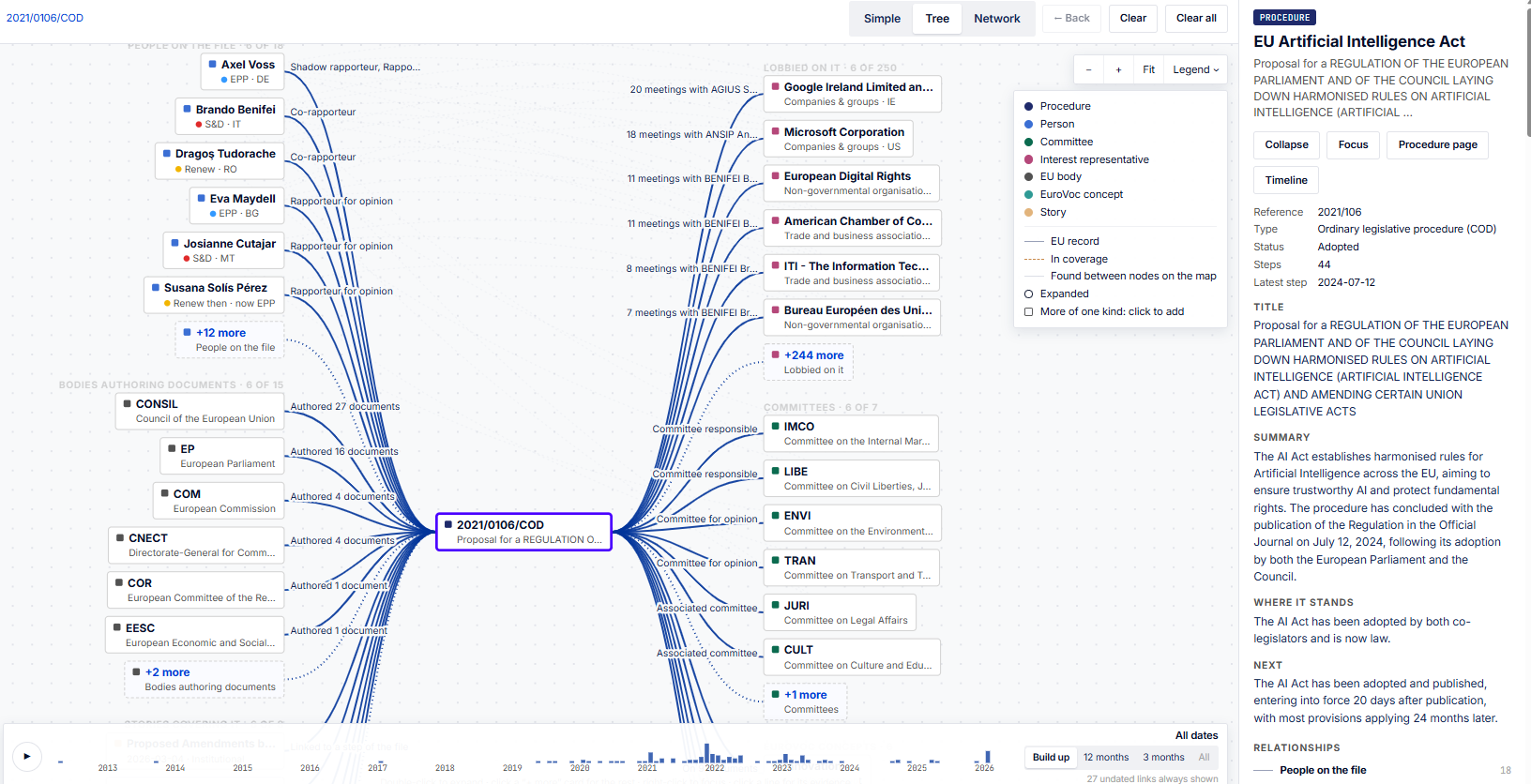
Beyond Monitoring: Discover the Latest Thembi Innovations
Thembi is continuously being updated.
 Alistair Stubbs
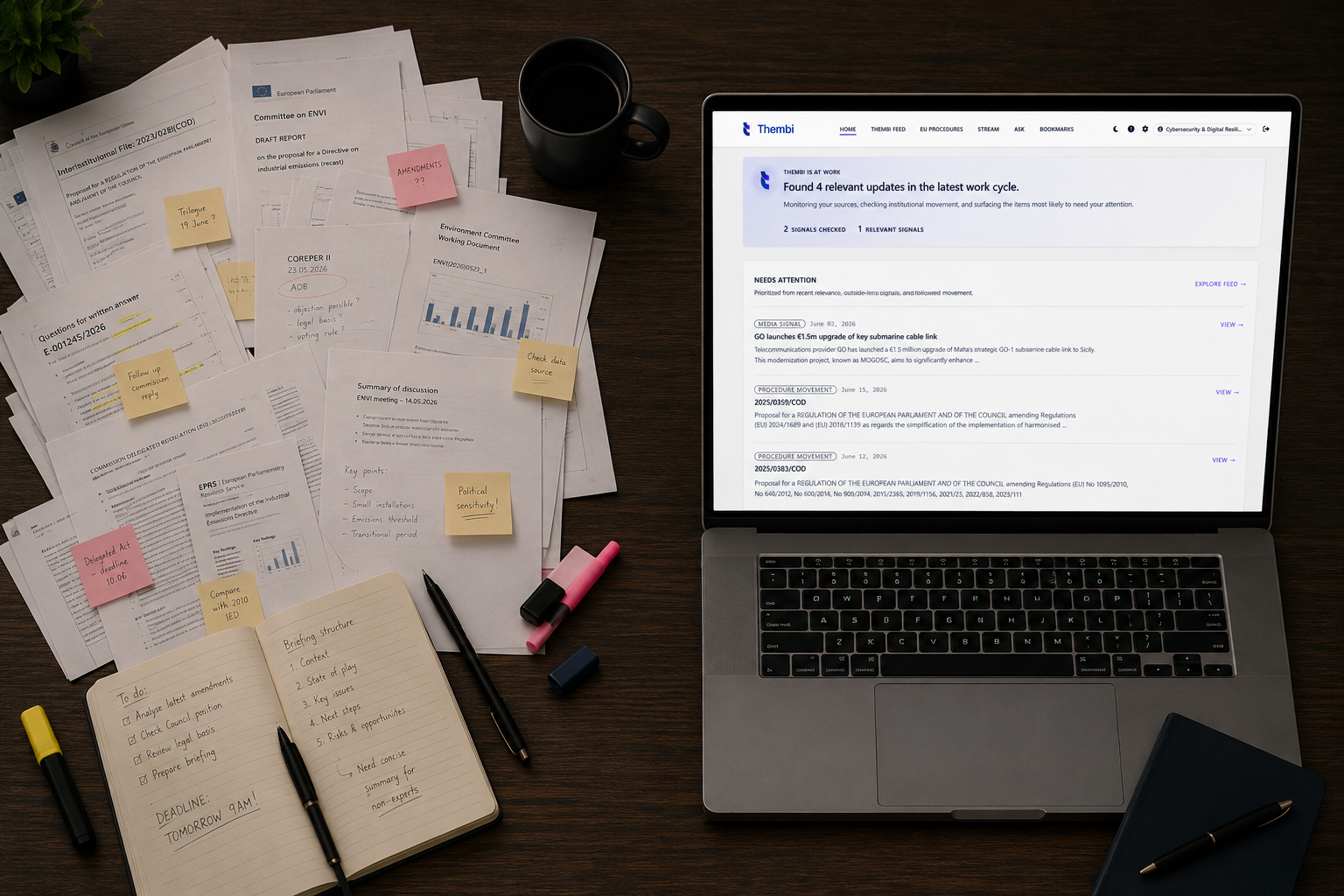
The 30% problem in EU policy work – and how to fix it
Ask anyone in the Brussels bubble where much of their time goes, and you’ll hear a version of the same challenge:
Sebastian Peter Sass 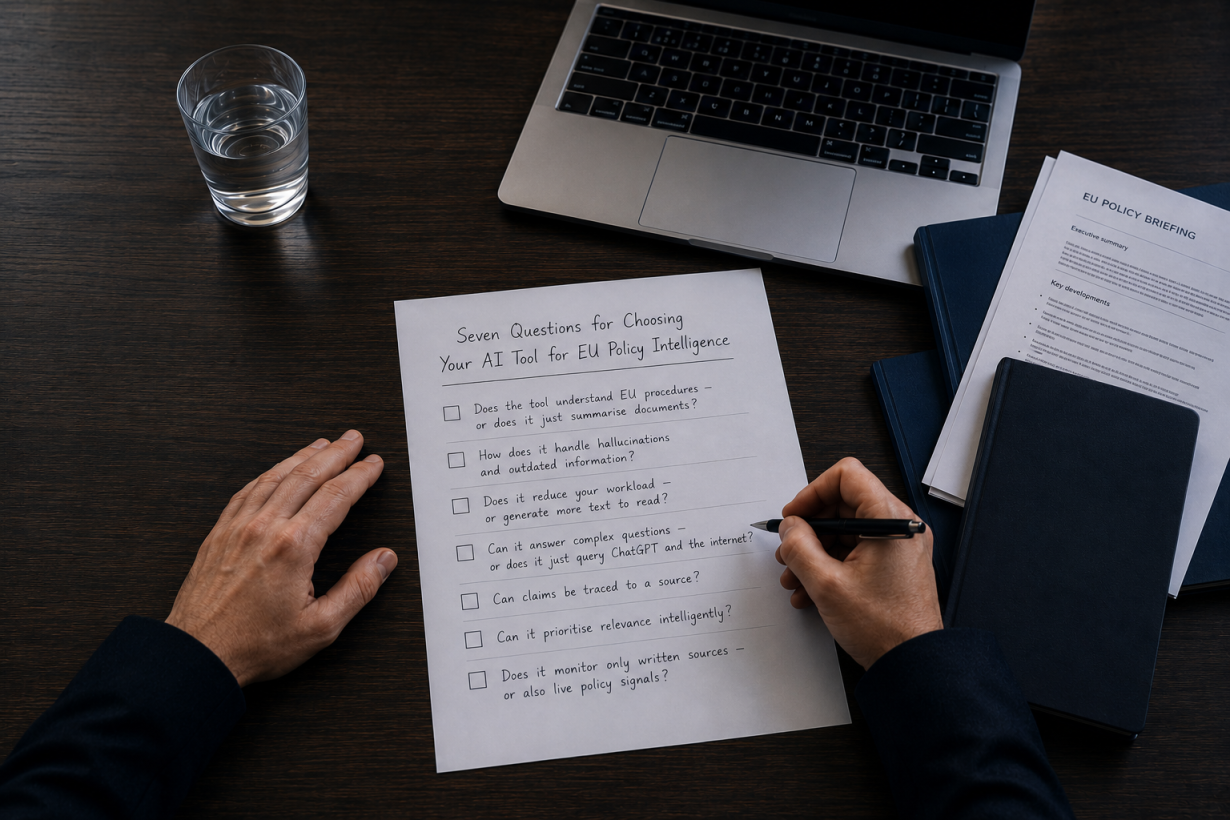
Seven Questions for Choosing Your AI Tool for EU Policy Intelligence
The volume of EU policy, regulatory and legislative activity is too large to follow manually.
Sebastian Peter Sass